
Stark County Most Wanted Notices
The Stark County Sheriff's Most Wanted page posts public notices for a small, curated set of wanted individuals, and visitors can send an anonymous tip straight from it. Updates arrive without a fixed schedule. There is no archive and no stated rule for how long a name stays up. The page is a tip line in webpage form, not a countywide warrant directory.
Photos are optional here. Some entries carry an image; others show none. Either way, the notice itself stands as published. Names and notice details are left to the Sheriff's site rather than repeated here, since a name on that list can change or come down at any moment. Anyone with information is the real audience, and the tip link is built for exactly that.
Status questions go somewhere else. The Sheriff's office or the court holding the warrant can confirm whether a notice still applies, so check with them before relying on anything the page shows.
Reading Stark County Wanted Listings
Read each listing as what the Sheriff chose to publish that day, not as a case file. A Stark County entry may carry identifying text, a last-known address, an offense label, physical descriptors, and date-of-birth information. Photos appear when available. None of these fields replace a case number, an active-warrant confirmation, or a court outcome. Details can shift through an arrest, a court action, a correction, or removal from the page.
| Notice field | What it can indicate |
|---|---|
| Identity details | The information the Sheriff chose to display for a notice, not a final identity determination. |
| Last-known address | A historical locating detail, not a current location or an invitation to make contact. |
| Offense label | The stated basis for the notice, not a court finding or final charge. |
| Physical descriptors | Agency-supplied descriptive information that should not be used to identify someone independently. |
| Photo status | An image may appear, but an observed notice can also have no photo. Neither result decides legal status. |
Note: A listing that is missing, dated, or thin should be described only as not found in that public notice when checked.
Stark County Tips and Safety
The notice includes an anonymous tip route. That is the channel to use with information that might help the Sheriff. Share only what you can convey safely. A tip line is not the place to ask whether someone has a warrant, request a case outcome, or arrange contact with a person. The Sheriff also promotes public-safety tools through its main office and a mobile app. Neither is documented as a current-custody or warrant-search service.
Safety first. Never approach, follow, identify, or try to detain anyone because of a wanted notice. Pass information to law enforcement. For an emergency, call 911.
A news story, a Calls for Service item, a publisher card, or a social media post gives you no authority to investigate anyone. Because the Sheriff publishes no update cadence for its page, direct confirmation matters even more whenever safety or legal status is at stake.
Checking Stark County Warrants
The most wanted list is not a countywide warrant search. Worried about a warrant in your own name? The safe path runs through the court, an attorney, or the responsible agency. Jurisdiction matters here, since county felony cases and city cases can follow different routes. A docket entry shows case activity. By itself it will not confirm a current warrant, a person's location, or jail custody.
- Identify the known court, agency, case number, and approximate date. Use the record that matches the question instead of relying on a publisher result or a notice snapshot.
- For a Stark County Common Pleas matter, start at the Clerk of Courts docket entry point and read the actual docket entries.
- For a city-level matter, use the Stark County court-information directory to reach the relevant municipal court. Do not assume the first court result is the complete history.
- Ask an attorney, the responsible court, or the responsible agency for direct guidance on a current personal warrant concern. This is the confirmation route when a docket or wanted notice is unclear.
- For an emergency or a tip about a listed notice, use 911 or the Sheriff's official tip route. Do not try to resolve the matter in person.
The countywide booking-record routes on the Stark County home page can help you tell an agency-held booking record apart from a court case. They still do not replace a warrant confirmation.
Stark County Warrant Types
Similar words can point to very different records. A notice, a court docket, and a custody system each answer a different question, and keeping their sources and scopes straight prevents a common mix-up.
| Record or notice | Appropriate use | Boundary |
|---|---|---|
| Sheriff's Most Wanted notice | Report information through the published tip path. | Curated notice only, not a full warrant inventory. |
| Court docket entry | Review filed case activity, entries, hearings, and disposition when present. | Requires court and agency confirmation for a current warrant question. |
| Jail booking record | Ask the records custodian about a specific responsive record. | Does not prove that a warrant is active or that a case is resolved. |
| Federal locator or wanted source | Use only for its separate federal scope. | Does not report a Stark County booking or local warrant status. |
Stark County Courts After Arrest
The jail and the Clerk answer different questions. A booking happens first, behind bars and cameras. Court activity comes later. The Clerk's Legal Division keeps that file for Common Pleas felony cases. Think dockets, arraignments, warrants, summonses, and subpoenas. One clock can move without the other, so a docket may linger after a person has been released or transferred elsewhere.
Online dockets reach back only to January 1, 1985. Anything older lives in the Clerk's historical index. That means a visit to the office. A blank search result proves nothing about pre-1985 records. Gather the case number, the court, and the right custodian before making a request.
The Legal Division sits at 115 Central Plaza North, Suite 101, Canton, OH 44702. It answers the phone at (330) 451-7801. It is separate from the jail and from the Sheriff's notice page. Municipal cases belong to the city court that handled them. The county Law Library's court-information directory points the way, covering the Alliance, Canton, and Massillon municipal routes. A case number and the court's own jurisdiction beat any city label a website may attach.
A warrant entry on a docket still needs context. One line of case activity cannot tell you whether a matter is active today. For a personal concern, ask the court, a lawyer, or the agency holding the file.
Note: Court records cover filed case activity and outcomes, while the Sheriff handles questions about a booking record or a releasable intake photograph.
Federal Results Aren't Stark Warrants
Federal lookups answer federal questions. The Federal Bureau of Prisons locator covers people in BOP custody. It does not cover anyone held at the Stark County Jail, booked by local deputies, or named on a county warrant. ICE's detainee locator works the same way, with its own scope and its own identifier rules. Searching either one tells you nothing about a Stark County court case or a Sheriff's question. That holds whether the search hits or comes up empty.
The official Federal Bureau of Prisons locator appears below so its federal scope stays clear and separate from Stark County records.
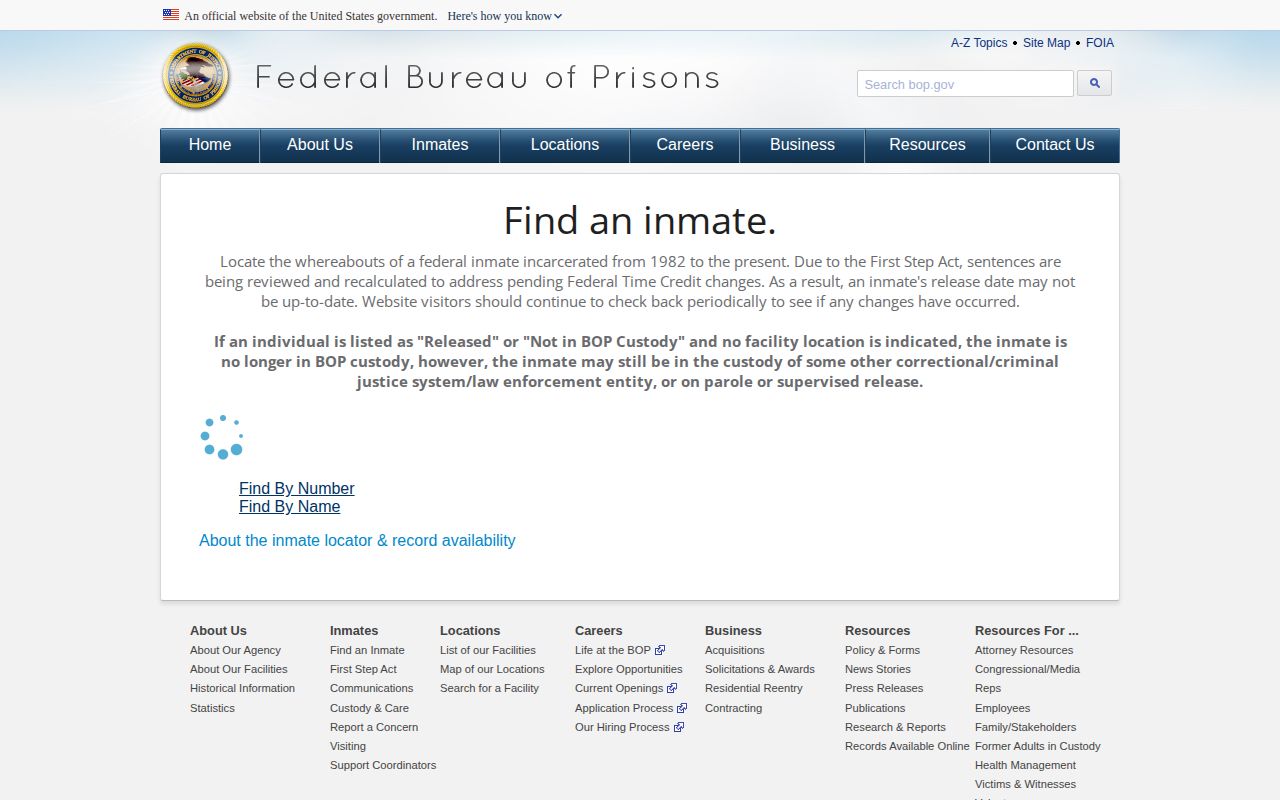
The BOP tool opens a federal record channel. That is all it does. No Stark County booking roster appears there. Treat any result as federal, never as county custody.
ODRC runs a separate lane. Its offender search covers people in Ohio prisons, under Department supervision, or judicially released. State corrections data helps only when the question is state status. It cannot show a fresh Stark County booking or current jail custody in Canton.
Stark County Wanted Record Gaps
Stark County's public sources leave real gaps. The Sheriff's jail material describes booking and intake photographs. Yet no public roster, booking-number search, daily feed, photo display, or posting schedule sits on the page. That absence settles nothing about a person. The public page simply cannot answer the question.
For a specific booking record, start with the Sheriff's published incident-and-accident request route. Say plainly what you need. Include a full name plus another identifier if you have one, a rough date, the arresting agency, and any report or booking number. Ask the Records Office whether releasable records exist, whether a different channel applies, and what a copy would cost before you commit. No published booking-photo fee or fixed response time appears anywhere.
These gaps also limit any wanted notice. Someone may be unlisted. They might have a court file hidden from online view, sit in another state or federal system, or need direct confirmation from an agency. Wording matters here. A result is what one named source showed, not a blanket statement about a person's situation.
Wanted Notices Are Not Verdicts
Notices change without explanation. A listing can be revised or removed, and a case behind it can shift in ways the page never reflects. The safe habit is simple: treat a wanted notice as a public-safety tool and take factual questions to the court that holds the case.
Identity demands caution, too. A shared name, a vague physical description, an old address, or a dated photo can point the wrong way. Never stitch entries together from separate sources by guesswork. When accuracy matters, pull the official case identifier and ask the agency or court that serves as custodian of the record.